Management system certified Bureau Veritas IT344936Our certification
Why grading matters
Grading is a cultural act of historical preservation.
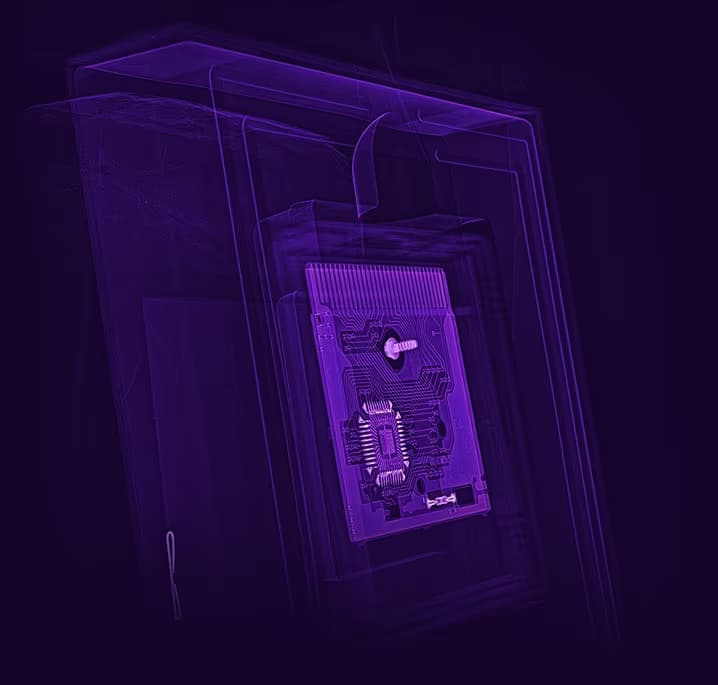
The method was not born with video games. It comes from American coins in 1949, moves on to comics and trading cards, and in 2008 it reaches cartridges: an independent judgment, a grade on a public scale, a seal nobody can alter. Since 2025 TGMGrading has brought the same rigor to Europe, with one technical difference: low-intensity X-ray scanning, which documents the contents of a sealed box without opening it.
The report that travels with the title is not a promise: it is a professional technical opinion, written so that anyone can read it again and check it. It states the condition of the piece, which parameters were measured and what the analysis found. The market decides the value, we provide the documentation.
Every title first goes through a hands-on inspection by our team. We look at the condition of the box and the seal, any signs of tampering, the labels and the overall visual integrity.
02
LOW-INTENSITY X-RAY SCANNING
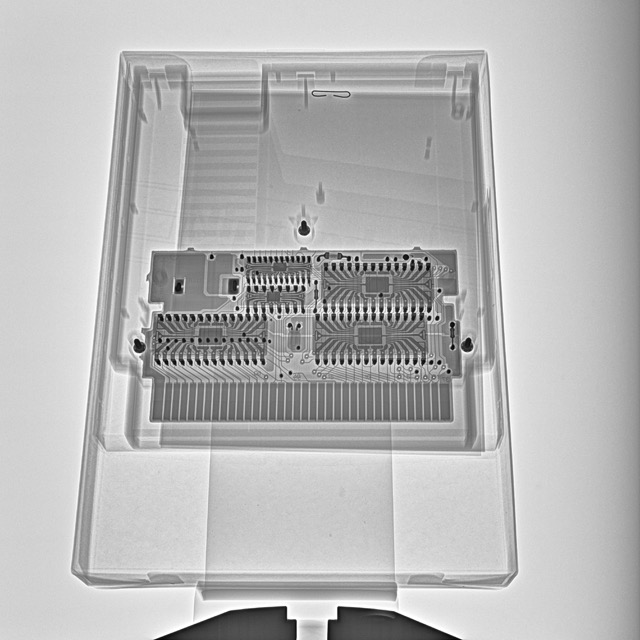
The heart of our process. This technology lets us see inside without opening the packaging. We map the presence and position of the contents, along with any anomalies, rebuilt elements or missing parts.
03
ANALYSIS OF HUNDREDS OF PARAMETERS
Every game is assessed in extremely technical detail. We take into account things like the type of shrink wrap used, where the staples sit in the manuals, the kind of ink on the covers, the weight, the size and other details invisible to the naked eye but decisive in telling an original from a fake or a reconditioned copy.
04
ASSESSMENT BY A PANEL OF EXPERTS
Our panel brings together people from very different fields: entrepreneurs, lawyers, notaries, video game producers, professional collectors and trade specialists. No assessment is left to chance.
05
AI SUPPORT
We have built a proprietary system that uses artificial intelligence to compare every single game against a database of hundreds of thousands of original copies.
06
ENCAPSULATION IN PREMIUM CASES
Every title is sealed inside a plexiglass case, 6 mm thick on the top and bottom and 4 mm on the sides, for high UV protection, bonded with high-performance industrial adhesives, the same ones used in the automotive industry. The result is a rigid, resilient and perfectly transparent shell. The design, in the Italian tradition, is worked down to the smallest detail: clean lines, elegance, legibility and timeless style.
LOW-INTENSITY X-RAY SCANNING
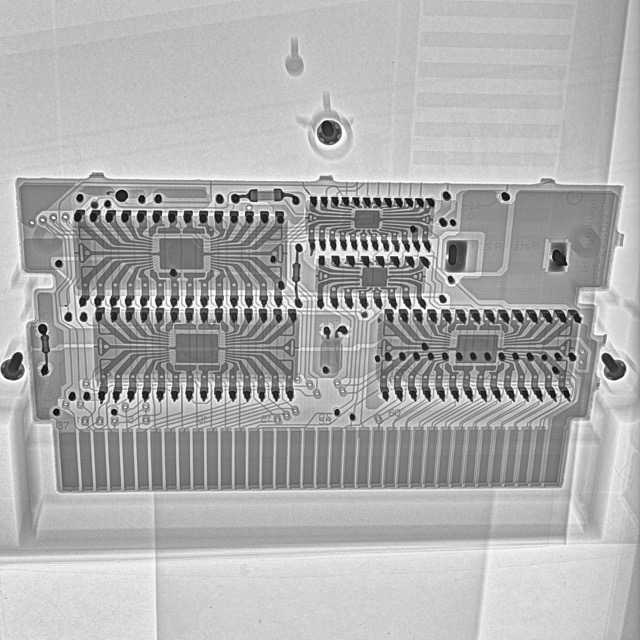
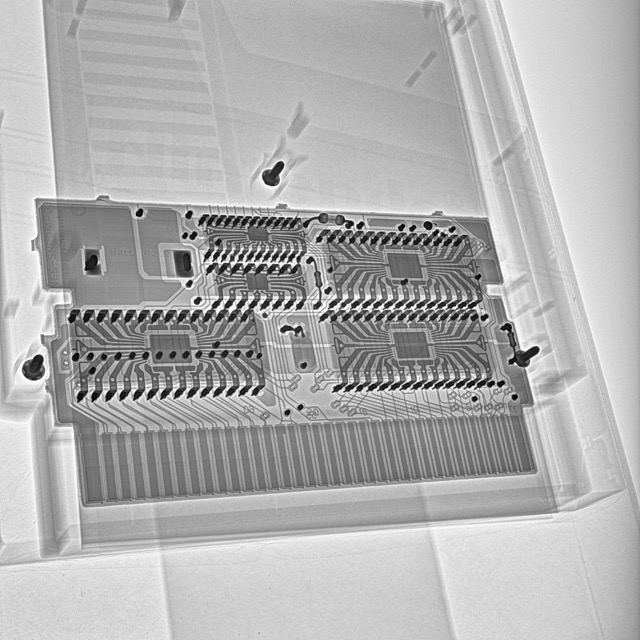
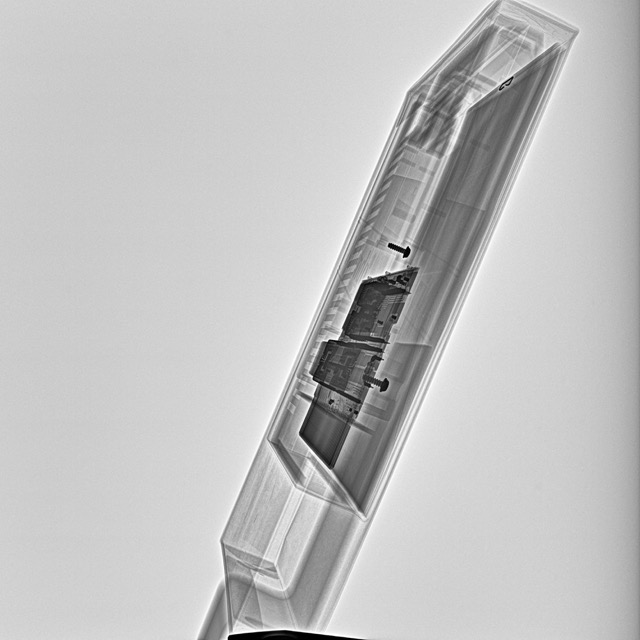
Result of an X-RAY scan
Unlike the high-intensity technology used for industrial inspections, our X-ray machine is calibrated specifically for the collectibles world. This is a €2,200,000 machine, built to work with millimeter-level delicacy:
No alteration to plastic or paper materials
No interference with inks, labels or seals
No exposure to radiation that could harm how the media works
The beam is controlled with enough precision to reveal manuals, serial numbers, board markings, discs or hidden inserts, at a depth and sharpness no other technology on the market can match.
TGMGrading
LATEST GRADED TITLES
The latest titles graded by TGMGrading, checked and sealed in premium cases. From Super Nintendo to PlayStation, from Mega Drive to PC Engine.
For collectors who want to grade a title without needing an X-ray scan. This service is recommended for CIB and NIB titles or recent sealed releases. Shipping details for your title will be sent to your registration email after purchase.
includes
Assessment of the title
Grading with a numeric grade
Encapsulation of the title
Tamper-proof bonding
X-Ray
+10 business days
Add-on service for collectors who want to know what is inside sealed titles or material that cannot be opened by hand. Low-intensity X-rays do not damage your pieces.
includes
Machine scanning
Low intensity X-rays
3 radiographs: front, side and electronics detail
Documentation printing
Written return letter
Full Delivery
Add-on service for anyone who would rather not deal with shipping. All you have to do is pack the item: we send the courier to your home or office to collect it, and ship it back wherever you want once grading is complete. Shipping details for your title will be sent to your registration email after purchase.
Service for non-standard titles that need a direct, tailored quote. Shipping costs, X-ray scanning costs (if you want it) and the build of the made-to-measure case are all calculated from the size of the title or console.
includes
Assistance and analysis
Custom case design
A direct line to our team
TGMGrading
MARKET COMPARISON
MARKET COMPARISON
TGMGrading
Other graders
X-ray scanning
YesPresent (low intensity)
NoAbsent
Full visual assessment
Yes
Yes
AI support in grading
Yes
No
Over 100 parameters assessed
Yes
No(Often 5 - 10 levels)
Thicker plexiglass cases for better UV protection
Yes
No(Standard acrylic)
Clean industrial adhesives
Yes
No
Multidisciplinary team (well-known collectors, lawyers, entrepreneurs and museums)
What is video game grading and why does it matter?
Grading is the process by which a video game in physical format is examined, documented and protected.
During the procedure, the game is:
1. Visually examined to identify defects, signs of age and any work carried out after production
2. Checked against its original elements: seal, manual, disc or cartridge, inserts
3. Graded on a public scale, the same one for every piece that comes into the laboratory
4. Sealed inside a clear, tamper-proof case that cannot be opened, carrying a label with the grade, the sub-grades and the certificate number
What remains at the end is a report: a professional technical opinion that describes the condition of the piece using the same parameters for everyone.
What is grading for?
1. It certifies the condition of the title on a standard scale, applied in the same way to every piece
2. It makes the assessment transparent and comparable: seller and buyer speak the same language
3. It protects the piece over time, closed inside a sealed case that shields it from dust, knocks and light
4. It documents the checks carried out, including what the X-ray scan finds inside a sealed box
5. It provides an objective reference outside the market too, for insurers, museums, exhibitions and collection inventories
Grading does not raise the value of a video game: it makes its condition legible. A certified piece is easier to assess and to trade, because the judgment no longer depends on how the seller describes it.
How are my titles evaluated?
TGMGrading assessments follow a technical grid built from hundreds of measurable parameters: quality of materials, condition, seal integrity, presence of the original elements, print alignment and much more.
Every assessment is then placed in context: we take into account the production standards of the era the title was released in and the average condition typical of that period. That is why two copies of the same title, examined months apart, receive exactly the same treatment.
Who evaluates my titles?
Grading is entrusted to a multidisciplinary team, led by two people:
1. Federico Salerno: lawyer and professional collector, a reference point for retrogaming in Italy, with years of legal and technical experience in protecting collectibles;
2. Carlo Santangostino: a pioneer of digital development and a historian of computing and video games, with decades of experience across e-commerce, multimedia and digital applications. One of Italy's most authoritative digital archaeologists, he brings a scientific and philological approach to placing titles in history.
Alongside them work other specialists: notaries, laboratory technicians, people from the video game industry and professionals with proven experience in buying and selling collectibles.
Where are my titles kept?
When a video game arrives at the laboratory, its physical security comes first.
Our operations site is fitted with:
1. Reinforced, alarmed security doors on every entrance
2. Internal anti-intrusion grilles protecting the rooms
3. Security fog systems that trigger on intrusion and cut visibility to zero
4. State-of-the-art alarms connected directly to law enforcement
5. Constant checks carried out by Fidelitas
Every package is tracked and checked at each stage of the process and stays in secure rooms before, during and after grading. Your title is never left unattended.
What is the difference between a certified copy and an uncertified one?
The difference lies in what you know about the piece, not in the price. On an uncertified copy the condition is described by the seller, in their own words, and the buyer has to take their word for it. On a certified copy the condition is written in a report, on a public scale, with a certificate number anyone can look up in the POP Report.
That is what grading adds: a common language made of the same scale, the same parameters and the same case. What a title is worth is then decided by the market, not by the report.
Can X-ray exposure damage cartridges, CDs, electronics or batteries?
X-rays are potentially harmful to electronic components and storage media in three cases: if the device is powered on, that is, if electricity is running through it, if the voltage used is higher than roughly 100 kV, or if the exposure is prolonged. Outside those conditions there is no danger, so much so that X-rays are one of the standard tools for non-destructive quality control on the electronic boards found in a huge range of objects, from home appliances to computers.
During our scans the intensity stays very low and each check lasts a few minutes at most.
Will the plastic and paper fade? Will the game become radioactive?
No. X-rays are high-energy photons, generated when electrons traveling at extremely high speed strike a target. The photons produced by the machine we use for certification do not carry the energy needed to alter the physical characteristics of an object, such as the color of plastic or paper, nor can they trigger the nuclear reactions that make a material radioactive.
How precise are the X-rays? What shows up and what does not?
The X-ray images we use to certify video games have a resolution of between 20 and 50 microns, that is, between 2 and 5 hundredths of a millimeter: enough to read every parameter needed for certification.
To be visible to X-rays, a material has to be dense enough to attenuate the energy of the photons passing through it, and that difference is picked up by a panel and returned as a grayscale image, on a principle similar to a digital camera. Some materials are very dense and therefore highly visible, for example the metals in electronic components and the staples in instruction booklets; others are less dense but still readable, such as the plastic of the case; others again are so light and so thin that they are barely perceptible or completely transparent, such as the paper in the booklets.
What intensity does the machine work at?
The machine can reach 500 watts of power and 300 kV of voltage, figures that penetrate metal several centimeters thick. For video games we work far lower: a maximum voltage of 70 to 80 kV and a very low current, between 60 and 70 microamperes, for a power output no higher than 8 watts. Video games are made mostly of low-density materials such as plastic: that restrained power is enough to obtain the images and leaves the item intact.
How much does it cost and how long does it take?
Grading starts at €50 per title and takes between 5 and 15 business days, depending on the service you choose and on the laboratory queue.
X-ray scanning is an add-on service and extends the process by around ten business days. Full delivery, available in Italy, includes pickup and return with an express courier. For non-standard items, such as complete consoles or bespoke cases, we quote on request.
What does ISO 9001:2015 certification mean?
It means that the way we work is subject to external audit: The Games Market has a management system certified ISO 9001:2015 Bureau Veritas IT344936.
The certification covers the organization, that is, written procedures, traceability of every piece, controls and continuous improvement. It does not certify individual video games or the grades assigned, which remain a professional technical opinion.
Can I see how many titles you have graded?
Yes. The TGMGrading POP Report is public and can be browsed from the site: it shows how many copies of each title went through the laboratory and with which grade, certificate by certificate.
It is the same tool collectors use to work out how rare a piece in a given condition really is, before buying or selling.